
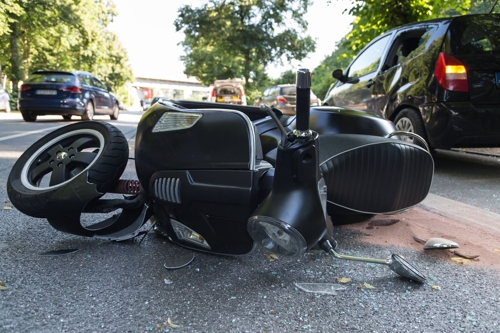
In M* v. M*, decided by the Appellate Division, First Department, the court addressed a dispute arising from a motor vehicle accident involving two individuals with the same surname. The case centered on a motion for partial summary judgment filed by plaintiff MAM, who sought a ruling on liability following a collision with an SUV driven by defendant GM.
The accident occurred on September 10, 2021, on East 14th Street near Avenue B in Manhattan. M was operating a moped and had picked up his romantic partner, co-plaintiff VO, en route to her home. According to M’s account, he was driving east when he approached a red light behind G’s SUV, which he described as a white security vehicle with lights on top. When the light turned green, the SUV began to move but then stopped abruptly. M attempted to pass the SUV, at which point G. allegedly initiated a U-turn, resulting in M’s moped striking the driver’s side of the SUV.
G’s version of events differed significantly. In his affidavit opposing the motion, he stated that he was fully stopped with his left turn signal engaged and had checked for traffic and pedestrians before beginning a U-turn. He claimed there were no signs prohibiting the maneuver and that it was safe to proceed. According to G, M. attempted to pass on the left by crossing a double yellow line and struck the SUV just before the U-turn was completed.
The Appellate Division found that these conflicting accounts created genuine issues of material fact regarding how the accident occurred and who was at fault. Because summary judgment is only appropriate when there are no triable issues, the court held that the lower court erred in granting M.’s motion. The order was reversed, and the motion denied.
This decision reinforces the principle that summary judgment is not appropriate when the parties present materially different versions of events, particularly in personal injury cases involving vehicle collisions. The presence of disputed facts requires resolution through trial or further proceedings, not through dispositive motion practice.
# # #
DECISION