
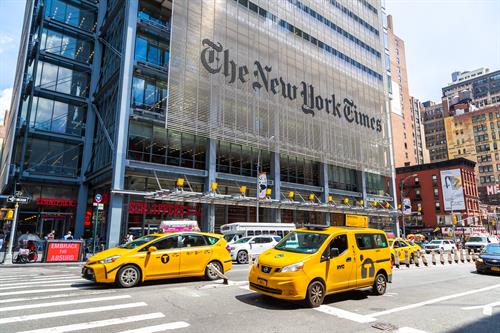
The U.S. Equal Employment Opportunity Commission’s lawsuit against The New York Times is more than a legal dispute. It is a moment of institutional irony so sharp it could cut newsprint.
For years, the Times has positioned itself as a national arbiter of equity, fairness, and moral clarity — a publication eager to diagnose systemic bias in every corner of American life. Yet according to the EEOC, the paper may have been practicing a form of discrimination it has long insisted is both pervasive and unforgivable.
The allegation is straightforward: a white male editor with extensive experience in real estate journalism was passed over for a promotion in favor of a non‑white female candidate with little to no experience in the field. The EEOC claims the Times not only excluded the longtime editor from the final interview panel but also advanced the external candidate outside the standard hiring process, despite internal evaluators rating her less favorably than other finalists.
In other words, the nation’s most influential newsroom — one that routinely warns readers about the dangers of bias — is now accused of allowing bias to guide its own decision‑making.
The DEI Paradox
The Times’s 2021 “Call to Action” laid out an ambitious set of race‑ and sex‑conscious goals for diversifying leadership. The document was celebrated in progressive circles as a model of corporate self‑reflection. But the EEOC’s lawsuit suggests that in the pursuit of those goals, the Times may have crossed a legal line.
EEOC Chair Andrea Lucas put it bluntly:
“There is no diversity exception to federal law.”
That statement lands with particular force when directed at an institution that has spent years insisting that discrimination — in any form — is intolerable. The Commission’s position is clear: Title VII prohibits employment decisions motivated in whole or in part by race or sex, regardless of the employer’s intentions or ideological commitments.
The Times, in its public posture, has often argued that equity requires proactive correction. The EEOC is now arguing that the law requires something else entirely: neutrality.
Merit, Process, and the Appearance of Fairness
The most striking element of the complaint is not the identity of the candidates but the alleged disregard for process. According to the EEOC, the chosen candidate bypassed standard interview requirements and was advanced despite weaker evaluations. If true, this is not merely a question of DEI philosophy — it is a question of institutional integrity.
A newsroom that demands transparency from others must demonstrate it internally. A newsroom that interrogates power must be accountable when it exercises its own.
The Broader Implications
This case arrives at a moment when DEI programs across the country are under heightened scrutiny. Critics argue that well‑intentioned initiatives have drifted into legally and ethically fraught territory. Supporters counter that systemic inequities require systemic remedies.
But the Times is not just any employer. It is a cultural institution whose editorial voice shapes national debates about fairness, justice, and discrimination. When such an institution is accused of violating the very principles it champions, the contradiction is impossible to ignore.
The lawsuit does not prove guilt. The Times will have its opportunity to respond, and the courts will determine the facts. But the allegations alone raise a question the paper has often posed to others: What happens when an institution’s stated values collide with its internal practices?
A Moment for Reflection
If the EEOC’s claims are accurate, the Times may find itself confronting a truth it has long urged others to accept: that discrimination, even when framed as progress, remains discrimination under the law.
And perhaps the most uncomfortable lesson of all is this:
When identity becomes the deciding factor, even for noble reasons, the result is not equity — it is exclusion.
The Times has spent years urging the country to grapple with uncomfortable realities. Now it may have to grapple with one of its own.
# # #
EEOC PRESS RELEASE
# # #